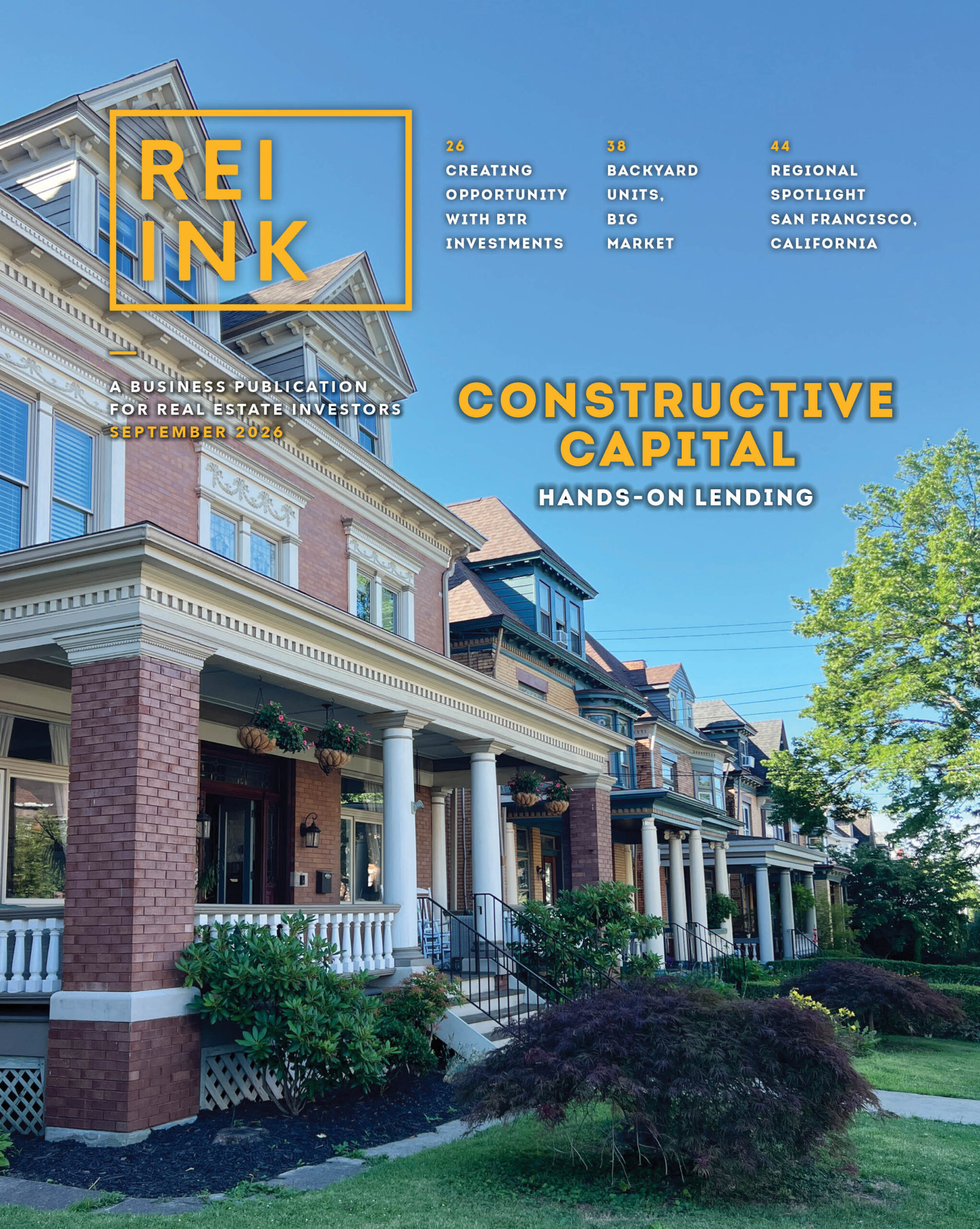

A Market Analysis of the Build-to-Rent Sector in 2026
by Beth O’Brien
Build-to-rent (BTR) is one of the hottest terms in residential real estate, but like so many other concepts, it is not a single product or even a singular living experience for its residents. It can be bungalows, townhomes, or detached single-family homes.
Many communities are amenitized with dog runs, clubhouses, and pools. In others, the amenities are simply a front door, a garage, and a backyard. From the investor’s perspective, the communities are managed like traditional multifamily — often with onsite leasing and maintenance. For some residents, BTR is the best way to gain access to certain schools and neighborhoods; for others, it’s simply a chance to live in a new home with none of the pressures of ownership.
Build-to-rent now comprises approximately 8% of all new single-family home starts, up significantly from the historical norm of 3 to 4%, driven by sustained demand from renters who are priced out of homeownership and a growing preference for the space and privacy of a single-family home without the financial commitment of buying. In areas where housing supply is constrained, BTR also provides much-needed inventory as households seek more affordable options in the locations they want to live.
How We Got Here: The Rise of Build to Rent
The BTR sector did not emerge overnight. Its roots trace back to the aftermath of the 2008 financial crisis, when institutional investors began acquiring distressed single-family homes at scale to operate as rentals. What began as an opportunistic strategy gradually evolved into a purpose-built asset class. Developers recognized that renters wanted more than an apartment but were not ready or able to buy. Building communities specifically designed for long-term rental occupancy with professional management and amenities was a natural response to that unmet demand. Multifamily developers and production home builders also took note and began entering the space.
The COVID-19 pandemic accelerated the trend dramatically. Remote work untethered millions of households from city centers, fueling demand for more space and suburban living. Homeownership became simultaneously more desirable and less attainable as home prices surged and mortgage rates climbed from historic lows. BTR communities sat squarely at the intersection of those forces — offering suburban space, private yards, and new construction quality without requiring a down payment or a 30-year commitment. Development pipelines that had been modest grew rapidly, and capital, both institutional and private, pivoted towards the sector.
Who Lives in Build-to-Rent Communities?
Understanding the BTR renter is essential to understanding the product. Despite the single-family format, BTR draws most of its residents from multifamily buildings rather than from the for-sale housing market. These are renters making an active lifestyle choice rather than households transitioning from renting to owning.
The renter profile is broad but skews toward households at key life transitions: young professionals settling into careers, couples and families with children who value access to good schools and quieter neighborhoods and downsizing empty nesters who want the ease of renting without the density of apartment living. Pet ownership is a significant driver as well — the backyard and dog-friendly orientation of most BTR communities is a genuine differentiator from conventional apartments.
Critically, some BTR residents are lifestyle renters — people who could afford to buy but choose not to. Flexibility, mobility, and freedom from maintenance responsibilities are frequently cited motivations. This segment has grown alongside the broader cultural shift toward renting as a long-term choice rather than a temporary compromise, particularly among millennials who came of age during the housing crisis and carry a more cautious relationship with homeownership than prior generations. Amherst estimates, however, that 80% of their tenants would not currently qualify for a mortgage but prefer to live in houses.
The Product Spectrum: Not All BTR Is the Same
One of the defining characteristics of the BTR sector is its variety. At one end of the spectrum sit horizontal apartment communities — clusters of detached or semi-detached cottages or bungalows laid out with multifamily-style density, shared amenity centers, and a design language borrowed from garden-style apartments. These projects benefit from economies of scale and efficient land use, and they often deliver strong absorption because the price point is more accessible.
Townhome communities represent the middle of the spectrum: attached two- or three-story homes with private entries, small patios or yards, and usually a garage. They are the most prevalent BTR product type nationally, offering a balance between density and the single-family experience that resonates with a wide range of renters.
At the other end of the spectrum sit single-family detached BTR communities: purpose-built neighborhoods of standalone homes with full yards, two-car garages, and the full single-family living experience. These communities are most common in lower land-cost markets, particularly in Texas and the Southeast, where the economics support building and operating detached homes at rental price points.
Geography: Where BTR Has Taken Root
BTR development has been heavily concentrated in the Sunbelt region. Markets like Phoenix, Dallas-Fort Worth, Atlanta, Charlotte, and Tampa led the first wave of purpose-built rental community development, drawn by population growth, in-migration from higher-cost coastal cities, affordable land, and a regulatory environment generally favorable to residential construction.
The Midwest has emerged as an increasingly attractive BTR market, characterized by strong fundamentals driven by constrained supply rather than explosive demand growth. Cities like Indianapolis, Columbus, Kansas City, and Milwaukee offer stable employment bases, relatively affordable land, and a renter population underserved by purpose-built rental product. Returns in these markets tend to be steadier if less dramatic than in high-growth Sunbelt metros, making them appealing to more conservative capital.
California and other coastal markets present a more complex picture. High land and construction costs make BTR development challenging to underwrite at rents that the market will bear. However, the sheer scale of housing undersupply in markets like the Inland Empire, Sacramento, and parts of the Pacific Northwest creates compelling demand conditions for operators who can navigate the cost structure.
The Management Advantage: Why Institutional Matters
One of the most important but least discussed aspects of BTR is the management model. Purpose-built rental communities are operated like multifamily properties with dedicated leasing teams, professional maintenance staff, centralized technology platforms, and formal resident services. This is a meaningful departure from the mom-and-pop landlord experience that defines much of the scattered single-family rental market.
The multifamily construct means predictable operating expenses, institutional-grade reporting, and the ability to benchmark performance against comparable assets. The management infrastructure also enables scale; a single operator can efficiently run hundreds of homes across a community.
The Road Ahead: Structural Tailwinds Remain Intact
Despite the near-term headwinds, the long-term structural case for build-to-rent remains compelling. The United States faces a chronic undersupply of housing that has been accumulating for over a decade. Homeownership affordability, already stretched before the rate increases of 2022–2023, remains out of reach for a significant and growing share of American households. The demographic wave of millennials forming households and seeking the space of suburban living has not abated. These are not cyclical forces; they are structural ones.
The aging of the housing stock also works in BTR’s favor. Much of the existing single-family rental inventory is aging, and renters increasingly value new construction with modern kitchens, energy-efficient systems, open floor plans, smart home technology over older homes with deferred maintenance.
What remains to be seen is if the current pending housing bill addresses build-to-rent as single family or if it eventually takes a more multifamily approach.
A Permanent Part of the Housing Landscape
Build to rent occupies a distinct and growing niche in the American housing landscape.
In the end, what makes build-to-rent work is not the product itself but the need it serves. As long as housing remains expensive to own, households will seek high-quality alternatives that offer the space and stability of a home without the financial exposure of ownership.
And that is not a flavor of the day, it is a structural component of U.S. housing stock.